
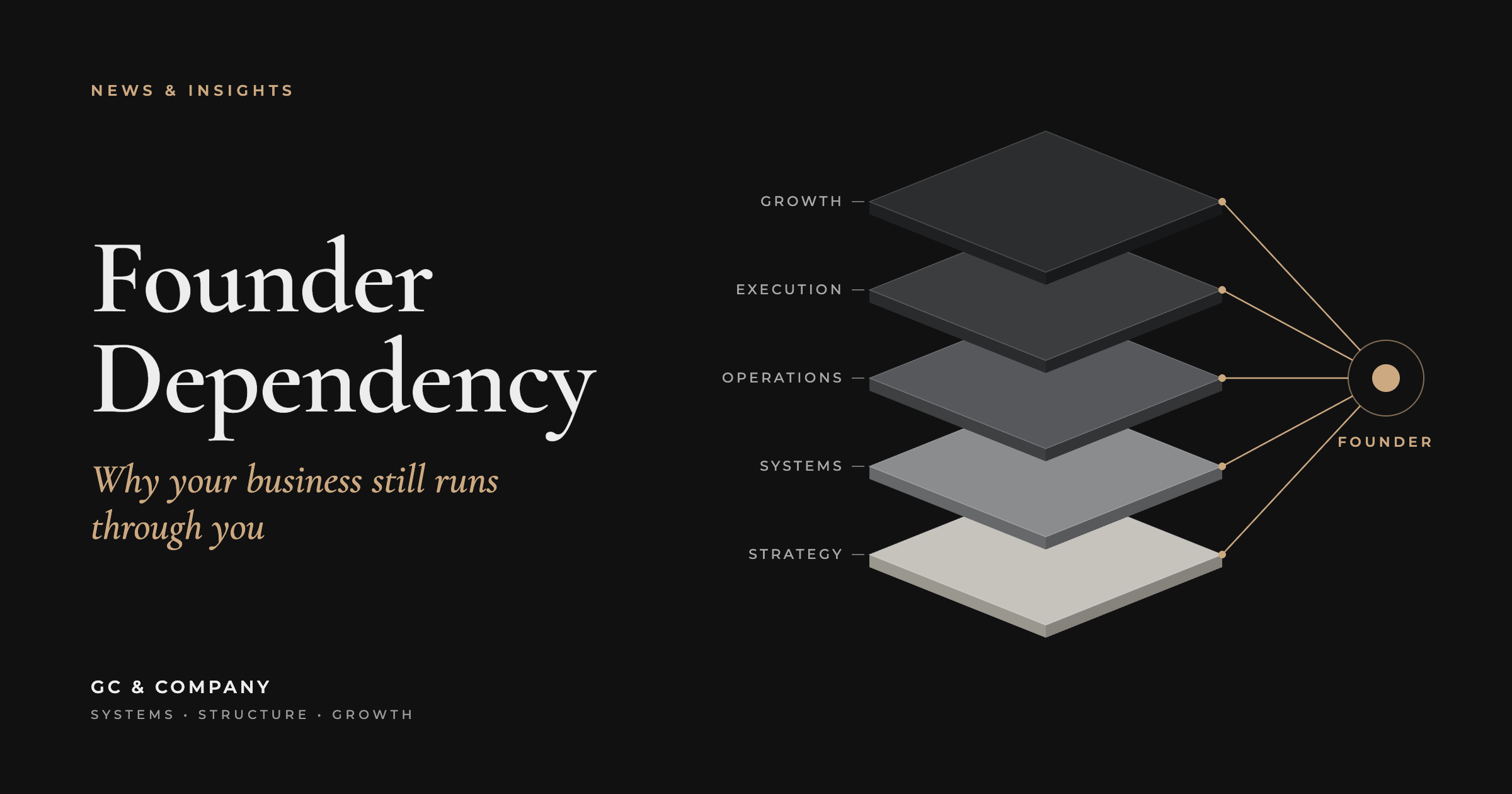
Founder Dependency: Why Your Business Still Runs Through You
Founder dependency is when a business can only move as fast as its founder can decide, approve or fix things. It rarely comes from a founder who refuses to let go. It comes from a business whose structure never caught up with its growth, so every question still finds its way back to one person.
You have probably felt some version of it:
Your team waits on you for decisions they could make themselves.
Leads cool off in the weeks you are busy delivering.
Quality depends on whether you reviewed the work.
Every launch, program or event gets rebuilt from scratch.
Taking a week off feels like a risk to the business.
This guide covers what founder dependency is, where it shows up across a service business, why the usual fixes do not stick, and how to reduce it.
What is founder dependency?
Founder dependency is a structural condition. Key decisions, knowledge and client relationships sit with the founder instead of in roles, workflows and systems. The business still works, but only while the founder holds it together.
It is not the same as being founder-led. In a founder-led business, the founder sets direction and stays the public face of the company. In a founder-dependent business, nothing moves without the founder. The first is a strength. The second is a ceiling.
Why it happens in growing service businesses
Founder dependency happens because the business added clients, offers and people faster than it added structure. Early on, the founder as the hub is efficient. Past a certain size, the same pattern becomes the bottleneck.
The pattern usually looks like this:
The founder sells, so client context lives in their head and their inbox.
Early hires are brought in to do tasks, not to own outcomes.
Tools are added one at a time, each solving a local problem.
Each new offer, program or event is built by hand.
The result is a business where the founder is still the project manager. Revenue may be growing. Capacity is not.
Where founder dependency shows up
It rarely sits in one place. It runs across the four layers of the business, which is why fixing one layer at a time often fails.
Layer | What it looks like | What it costs |
|---|---|---|
Marketing | Content and campaigns wait for founder approval. The message lives in the founder's head. | Inconsistent visibility and launches that slip. |
Sales | Only the founder can qualify, propose and follow up. Leads sit in an inbox or a spreadsheet. | Leads go cold whenever the founder is busy delivering. |
Delivery | Quality depends on founder review. Onboarding is rebuilt for each client. | Capacity is capped at the founder's hours. |
Operations | Roles and ownership are unclear. Decisions get escalated. Information is scattered across tools. | Coordination costs rise with every hire. |
Why the usual fixes do not stick
Most fixes target one layer while the dependency runs across all of them. They relieve pressure for a few weeks, and then the questions start coming back.
Hiring without decision rights. A new assistant or manager without the authority to decide becomes a messenger between the team and the founder.
Buying software first. A tool without a workflow and an owner becomes storage. Your CRM holds contacts, but nobody follows up.
Adding more marketing. More leads flow into a sales and delivery system that cannot hold them.
Working longer hours. It postpones the problem and makes the founder harder to replace in every role they hold.
How to reduce founder dependency
You reduce founder dependency by moving decisions, knowledge and follow-through out of your head and into owned workflows. Do it one layer at a time, starting where the bottleneck actually sits.
Diagnose before you delegate. For two weeks, list every decision, request and approval that comes to you. Tag each one by layer: marketing, sales, delivery or operations. Look for where they cluster.
Separate judgment from routine. For each recurring item, decide whether it truly needs your judgment, can follow a rule, or should belong to someone else.
Assign owners with decision rights. An owner can decide within defined limits without asking. Write the limits down.
Build the workflow around the owner. Give each owner the system that makes the work repeatable: stages in the CRM, a checklist, a handoff, a template.
Review weekly until it holds. Hold a short weekly review of exceptions. You handle the exceptions. The routine stays with the owner.
This is the same sequence behind how we diagnose the real bottleneck: diagnose, design, implement and embed.
Founder dependency usually becomes visible at a trigger point: a launch, an expansion, a new program, a rebrand or a busy delivery stretch when sales quietly stop. If one of those is coming in the next 90 days, start now, before the extra load lands on you.
What changes when the business stops running through you
The founder does not disappear. The role changes from approving everything to setting direction, owning key relationships and handling true exceptions.
You will notice it in small ways first. The team resolves routine issues without escalating. Leads get followed up while you are traveling. New clients are onboarded the same way every time. Your calendar has room for strategy again.
For NAS Wireless, a network infrastructure and services business, our work began with project management and expanded into broader operational support. It connected operational decisions, team coordination and commercial priorities instead of treating each as an isolated task. Read the NAS Wireless case study.
Is founder dependency holding your business back?
If your business still runs through you, a short conversation is the fastest way to see where the dependency sits. Go to our Fit Call page to book a free 15-minute call: fill in the short form and pick a time that works for you. Not ready to book? Send the form on its own and we will follow up by email.
Frequently asked questions
What is founder dependency? Founder dependency is when key decisions, knowledge and client relationships sit with the founder instead of in roles, workflows and systems. The business works, but only while the founder holds it together, which caps growth at the founder's capacity.
Is founder dependency the same as a founder-led business? No. A founder-led business has a founder who sets direction and is the public face of the company. A founder-dependent business cannot move without the founder. You can stay founder-led while removing founder dependency.
How do I know if my business is founder dependent? Common signs: routine decisions wait for you, leads stall when you are busy delivering, quality depends on your review, and every launch is rebuilt by hand. If taking a week off feels risky, the business likely depends on you.
Can hiring a COO or operations manager fix founder dependency? Only if the role comes with defined decision rights, owned workflows and working systems. Without them, a new hire becomes one more person waiting for the founder's answer.